
LangChainについては下記で少し扱いましたが、今回はLangGraphと組み合わせて使ってみました。
LangGraphは名のとおり制御フローをグラフ構造を記述するのに向いており、ビジュアルツールなどをつかったワークフローでなくPythonで記述したい場合、有用だと思っています。
https://decode.iiv.jp/blog/202508091968/index.html
https://decode.iiv.jp/blog/202507191951/index.html
特徴的な部分は、_build_graph() です。
判定結果に応じて選択するノードを切り替えています。このプログラムは質問内容によってLLMを切り替えるデモです。GPUメモリを利用できる設定にしてあります。
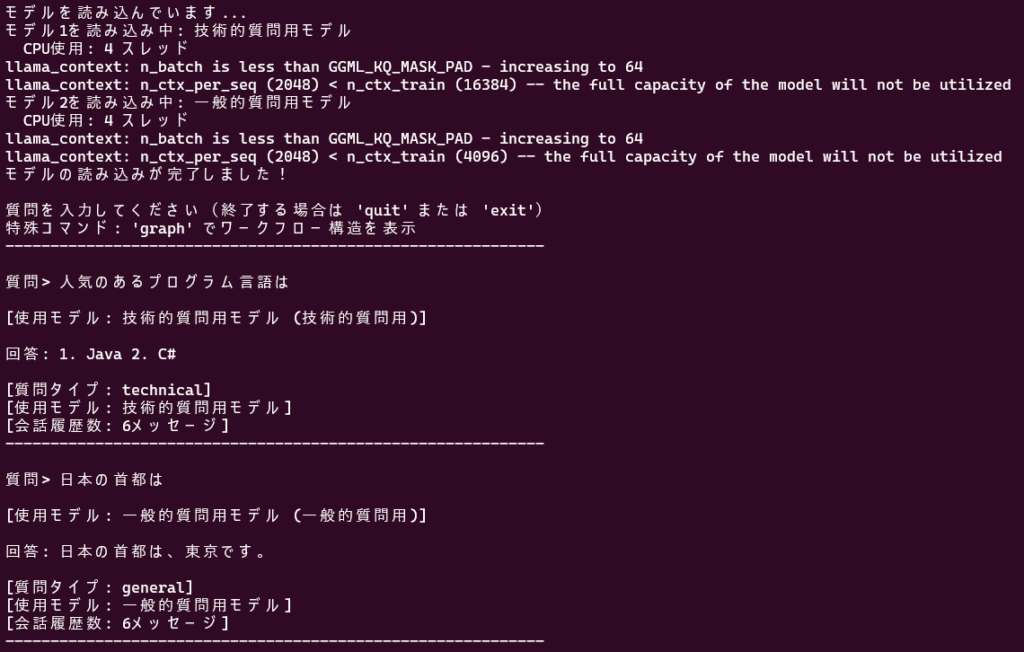
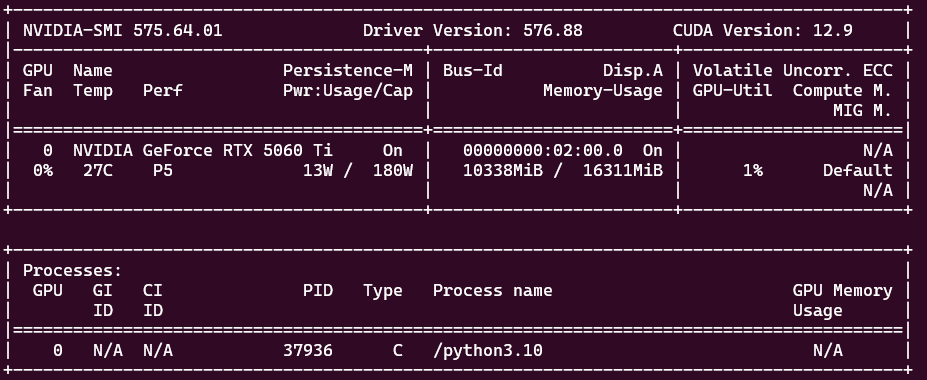
#!/usr/bin/env python3
"""
LangGraphのステート管理とワークフローに、LangChainのLCELチェーンを組み合わせた実装
"""

from typing import TypedDict, Annotated, Literal
from langchain_community.llms import LlamaCpp
from langchain_core.prompts import PromptTemplate
from langchain_core.runnables import RunnableLambda
from langchain_core.output_parsers import StrOutputParser
from langchain_core.messages import HumanMessage, AIMessage, BaseMessage
from langgraph.graph import StateGraph, END
import operator
import json


class GraphState(TypedDict):
    """グラフの状態を管理する型定義"""
    messages: Annotated[list[BaseMessage], operator.add]
    question: str
    question_type: Literal["technical", "general", ""]
    model_name: str
    response: str


class LLMRouterHybrid:
    """LangChain + LangGraph ハイブリッドルーター"""

    def __init__(self, config_path="config.json"):
        """
        初期化

        Args:
            config_path: 設定ファイルのパス
        """
        with open(config_path, 'r', encoding='utf-8') as f:
            self.config = json.load(f)

        print("モデルを読み込んでいます...")

        # モデル1: 技術的な質問用(LangChainのLlamaCppラッパー)
        print(f"モデル1を読み込み中: {self.config['model1']['name']}")
        n_gpu_layers_1 = self.config['model1'].get('n_gpu_layers', 0)
        if n_gpu_layers_1 > 0:
            print(f"  GPU使用: {n_gpu_layers_1} レイヤーをGPUにオフロード")
        else:
            print(f"  CPU使用: {self.config['model1']['n_threads']} スレッド")

        self.model1 = LlamaCpp(
            model_path=self.config['model1']['path'],
            n_ctx=self.config['model1']['n_ctx'],
            n_threads=self.config['model1']['n_threads'],
            n_gpu_layers=n_gpu_layers_1,
            max_tokens=512,
            temperature=0.7,
            top_p=0.9,
            verbose=False,
            stop=["質問:", "\n\n"]
        )

        # モデル2: 一般的な質問用(LangChainのLlamaCppラッパー)
        print(f"モデル2を読み込み中: {self.config['model2']['name']}")
        n_gpu_layers_2 = self.config['model2'].get('n_gpu_layers', 0)
        if n_gpu_layers_2 > 0:
            print(f"  GPU使用: {n_gpu_layers_2} レイヤーをGPUにオフロード")
        else:
            print(f"  CPU使用: {self.config['model2']['n_threads']} スレッド")

        self.model2 = LlamaCpp(
            model_path=self.config['model2']['path'],
            n_ctx=self.config['model2']['n_ctx'],
            n_threads=self.config['model2']['n_threads'],
            n_gpu_layers=n_gpu_layers_2,
            max_tokens=512,
            temperature=0.7,
            top_p=0.9,
            verbose=False,
            stop=["質問:", "\n\n"]
        )

        print("モデルの読み込みが完了しました!\n")

        # 技術的な質問を判定するキーワード
        self.technical_keywords = [
            'コード', 'プログラム', 'python', 'javascript', 'java', 'c++',
            'アルゴリズム', '関数', 'クラス', 'エラー', 'バグ',
            '数学', '計算', '方程式', '証明', 'データ構造',
            'api', 'データベース', 'sql', 'html', 'css',
            '実装', 'デバッグ', 'コンパイル', 'ライブラリ',
            'code', 'program', 'algorithm', 'function', 'debug'
        ]

        # LangChainのプロンプトテンプレートを作成
        self.prompt_template = PromptTemplate(
            input_variables=["question"],
            template="質問: {question}\n回答: "
        )

        # LangChainのLCELチェーンを構築(各モデル用)
        self.technical_chain = (
            self.prompt_template
            | self.model1
            | StrOutputParser()
        )

        self.general_chain = (
            self.prompt_template
            | self.model2
            | StrOutputParser()
        )

        # LangGraphのワークフローを構築
        self.graph = self._build_graph()

    @staticmethod
    def _clean_text(text: str) -> str:
        """
        テキストから不正なUnicode文字を削除

        Args:
            text: クリーンアップするテキスト

        Returns:
            クリーンアップされたテキスト
        """
        # サロゲートペアや不正な文字を削除
        return text.encode('utf-8', errors='ignore').decode('utf-8', errors='ignore')

    def classify_question(self, question: str) -> str:
        """
        質問を分類する

        Args:
            question: ユーザーからの質問

        Returns:
            'technical' または 'general'
        """
        question_lower = question.lower()

        # 技術的なキーワードが含まれているかチェック
        for keyword in self.technical_keywords:
            if keyword in question_lower:
                return 'technical'

        # コードブロックが含まれているかチェック
        if '```' in question or 'def ' in question or 'class ' in question:
            return 'technical'

        return 'general'

    def _classify_node(self, state: GraphState) -> GraphState:
        """
        質問を分類するノード(LangGraphノード)

        Args:
            state: 現在の状態

        Returns:
            更新された状態
        """
        question = state["question"]
        question_type = self.classify_question(question)

        state["question_type"] = question_type
        return state

    def _route_question(self, state: GraphState) -> Literal["technical_model", "general_model"]:
        """
        質問のタイプに基づいてルーティング先を決定(LangGraph条件分岐)

        Args:
            state: 現在の状態

        Returns:
            次のノード名
        """
        if state["question_type"] == "technical":
            return "technical_model"
        else:
            return "general_model"

    def _technical_model_node(self, state: GraphState) -> GraphState:
        """
        技術的な質問用モデルで回答を生成するノード
        ノード内でLangChainのLCELチェーンを実行

        Args:
            state: 現在の状態

        Returns:
            更新された状態
        """
        question = self._clean_text(state["question"])
        model_name = self.config['model1']['name']

        print(f"[使用モデル: {model_name} (技術的質問用)]\n")

        # LangChainのLCELチェーンを実行
        response = self.technical_chain.invoke({"question": question})
        response = self._clean_text(response.strip())

        # LangGraphのステートを更新
        state["response"] = response
        state["model_name"] = model_name
        state["messages"].append(AIMessage(content=response))

        return state

    def _general_model_node(self, state: GraphState) -> GraphState:
        """
        一般的な質問用モデルで回答を生成するノード
        ノード内でLangChainのLCELチェーンを実行

        Args:
            state: 現在の状態

        Returns:
            更新された状態
        """
        question = self._clean_text(state["question"])
        model_name = self.config['model2']['name']

        print(f"[使用モデル: {model_name} (一般的質問用)]\n")

        # LangChainのLCELチェーンを実行
        response = self.general_chain.invoke({"question": question})
        response = self._clean_text(response.strip())

        # LangGraphのステートを更新
        state["response"] = response
        state["model_name"] = model_name
        state["messages"].append(AIMessage(content=response))

        return state

    def _build_graph(self) -> StateGraph:
        """
        LangGraphのワークフローを構築

        Returns:
            コンパイル済みのグラフ
        """
        # LangGraphのStateGraphを作成
        workflow = StateGraph(GraphState)

        # ノードを追加
        workflow.add_node("classify", self._classify_node)
        workflow.add_node("technical_model", self._technical_model_node)
        workflow.add_node("general_model", self._general_model_node)

        # エントリーポイントを設定
        workflow.set_entry_point("classify")

        # 条件分岐エッジを追加(LangGraphのルーティング)
        workflow.add_conditional_edges(
            "classify",
            self._route_question,
            {
                "technical_model": "technical_model",
                "general_model": "general_model"
            }
        )

        # 終了エッジを追加
        workflow.add_edge("technical_model", END)
        workflow.add_edge("general_model", END)

        # グラフをコンパイル
        return workflow.compile()

    def process_question(self, question: str) -> dict:
        """
        質問を処理して回答を生成
        LangGraphワークフローを実行

        Args:
            question: ユーザーからの質問

        Returns:
            処理結果(状態)
        """
        # 質問をクリーンアップ
        cleaned_question = self._clean_text(question)

        # 初期状態を作成
        initial_state: GraphState = {
            "messages": [HumanMessage(content=cleaned_question)],
            "question": cleaned_question,
            "question_type": "",
            "model_name": "",
            "response": ""
        }

        # LangGraphのワークフローを実行
        result = self.graph.invoke(initial_state)

        return result

    def visualize_graph(self):
        """
        グラフを可視化(要graphviz)
        """
        try:
            from IPython.display import Image, display
            display(Image(self.graph.get_graph().draw_mermaid_png()))
        except Exception as e:
            print(f"グラフの可視化にはgraphvizとIPythonが必要です: {e}")
            print("\nグラフ構造(テキスト表現):")
            print("START → classify → [technical_model | general_model] → END")
            print("\n各ノード内でLangChainのLCELチェーンを実行:")
            print("  technical_model: PromptTemplate | LlamaCpp(model1) | StrOutputParser")
            print("  general_model: PromptTemplate | LlamaCpp(model2) | StrOutputParser")


def main():

    try:
        router = LLMRouterHybrid()
    except FileNotFoundError:
        print("エラー: config.jsonが見つかりません。")
        print("config.jsonを作成してモデルのパスを設定してください。")
        return
    except Exception as e:
        print(f"エラー: {e}")
        import traceback
        traceback.print_exc()
        return

    print("質問を入力してください(終了する場合は 'quit' または 'exit')")
    print("特殊コマンド: 'graph' でワークフロー構造を表示")
    print("-" * 60)
    print()

    while True:
        try:
            question = input("質問> ").strip()

            if not question:
                continue

            if question.lower() in ['quit', 'exit', 'q']:
                print("終了します。")
                break

            # 特殊コマンド: グラフの可視化
            if question.lower() == 'graph':
                router.visualize_graph()
                print()
                continue

            print()
            result = router.process_question(question)
            print(f"回答: {result['response']}")
            print()
            print(f"[質問タイプ: {result['question_type']}]")
            print(f"[使用モデル: {result['model_name']}]")
            print(f"[会話履歴数: {len(result['messages'])}メッセージ]")
            print("-" * 60)
            print()

        except KeyboardInterrupt:
            print("\n\n終了します。")
            break
        except Exception as e:
            print(f"エラーが発生しました: {e}")
            import traceback
            traceback.print_exc()
            print()


if __name__ == "__main__":
main()config.json
{
  "model1": {
    "name": "技術的質問用モデル",
    "path": "codellama-7b.Q4_K_M.gguf",
    "n_ctx": 2048,
    "n_threads": 4,
    "n_gpu_layers": -1,
    "description": "コーディング、数学、技術的な質問に特化したモデル"
  },
  "model2": {
    "name": "一般的質問用モデル",
    "path": "llama-2-7b-chat.Q4_K_M.gguf",
    "n_ctx": 2048,
    "n_threads": 4,
    "n_gpu_layers": -1,
    "description": "雑談、創作、一般的な質問に対応するモデル"
  },
  "gpu_settings": {
    "enabled": false,
    "comment": "n_gpu_layers: GPUにオフロードするレイヤー数。0=CPU only, -1=全層GPU, 35=35層をGPUに"
  }
}
入力文字によってはUTF-8に関するエラーが発生していたので、チェックロジックがいろいろはいっています。
Claude Code でいろいろ指示をしながら作成しました。